Repair or Replace a 20-Year-Old Garage Door?
Whether to repair or replace a 20-year-old garage door comes down to two things: the condition of the door panels themselves, and how many worn parts are due at once. If the door is sound and one wear part has failed, repair it. If the panels are tired and several big repairs are lining up, replacement usually wins.
This guide explains why so many Nampa homeowners face this question now, the half-the-cost rule, the signs on each side, how to compare quotes honestly, what a new door gets you in our climate and a middle path many people overlook.
Why this question is everywhere in Nampa right now
Nampa’s largest group of homes, about 11,539 of them, was built between 2000 and 2009. Their original garage doors are now 17 to 26 years old, and so are the springs, cables, rollers and openers that came with them, unless something has already been replaced. Doors last roughly 15 to 30 years depending on construction, so a lot of households are reaching the same fork in the road at roughly the same time.
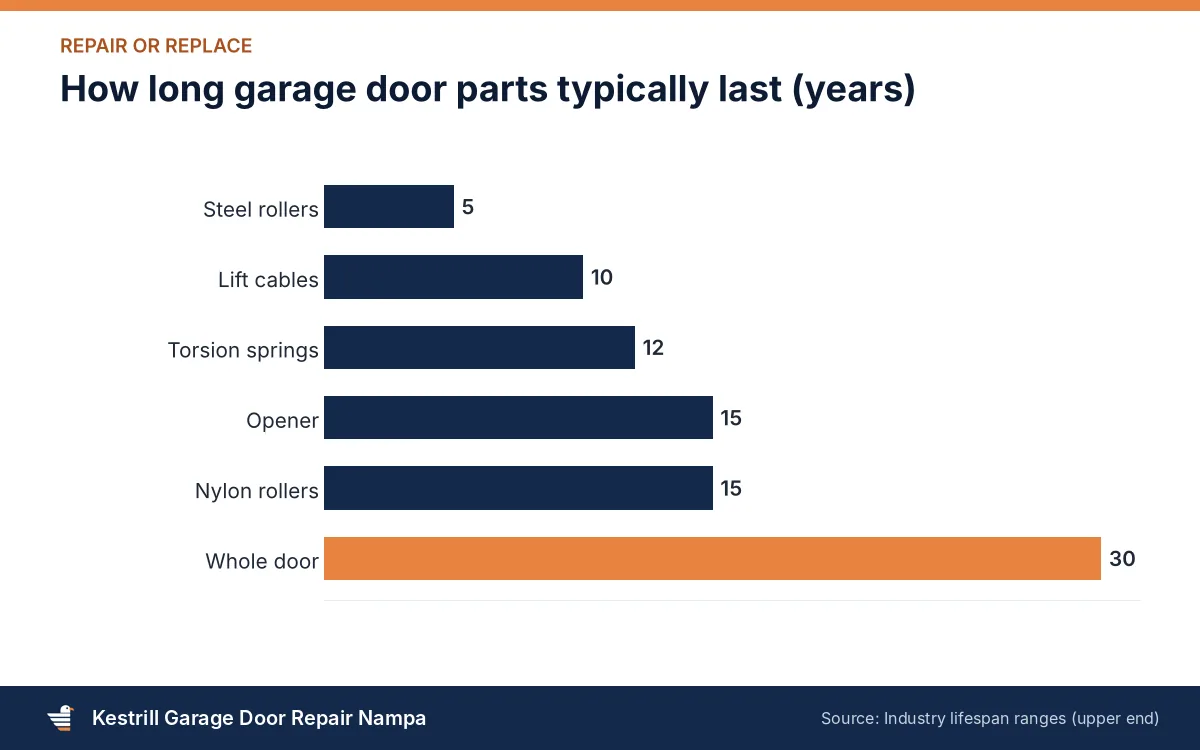
The parts do not age together. Springs, cables and rollers wear out on a cycle count, the opener on age and use, and the door panels on weather and knocks. A 20-year-old door may have had two sets of springs and a new opener and still have years left, or it may be faded, dented and rusting along the bottom with every part tired at once. The decision depends on which of those describes yours.
The half-the-cost rule
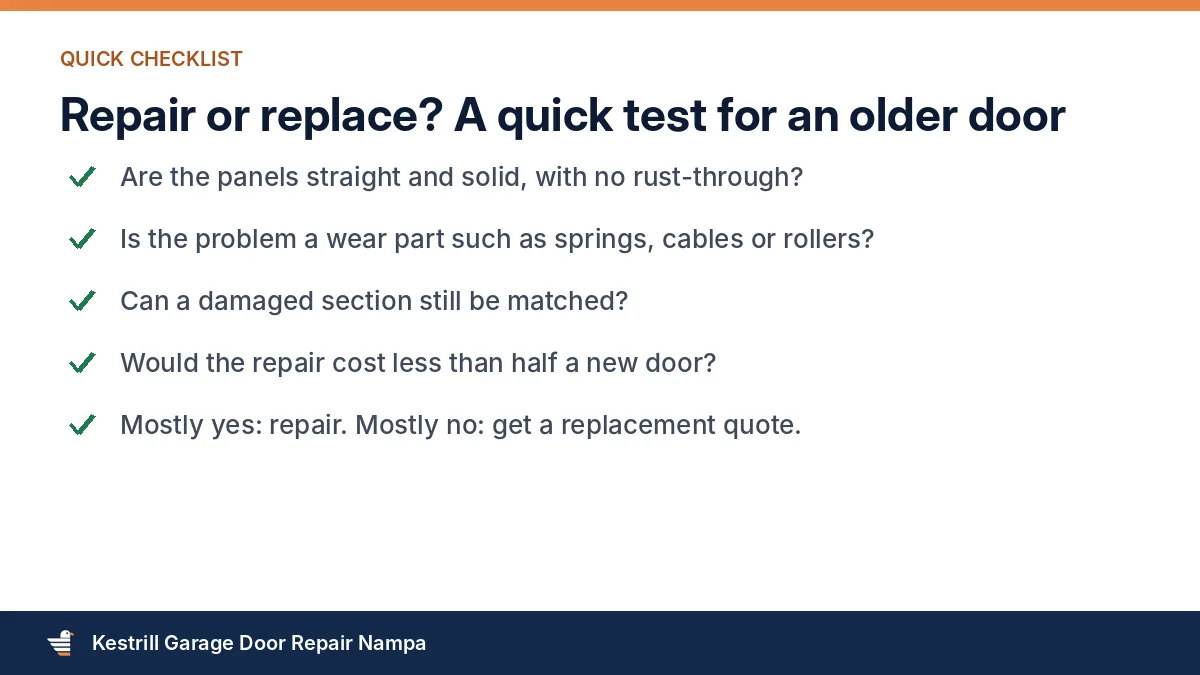
The most widely used rule of thumb is simple: if a repair would cost more than about half the price of a new door, replace the door. Age shifts the line. On a five-year-old door, almost any repair is worth doing. On a 20-year-old door, a single repair that comes close to half the price of a new one usually is not, because the next repair is not far behind.
Signs repair still makes sense
- The door panels are straight, solid and not rusting through at the bottom.
- The problem is a wear part: springs, cables, rollers, hinges or a seal.
- Any damaged section can still be matched, because the model is still made.
- The door is reasonably quiet and balanced once the worn parts are replaced.
- You are happy with how it looks and how warm or cool the garage stays.
Springs, in particular, are a normal wear item, not a sign the door is finished. A spring replacement on a sound 20-year-old door is a perfectly sensible repair; the broken spring repair page explains what is involved.
Signs it is time to replace the door
- Several sections are dented, creased or bowed, or the bottom section has rusted or rotted through.
- A damaged section cannot be matched because the model was discontinued.
- You face several major repairs at once: springs, cables, rollers and an opener.
- The door is uninsulated beside a living space, and the garage is freezing in January and baking in July.
- It is a heavy wood or hardboard door straining its springs and opener.
- You are selling soon and the door is the most visible tired thing on the front of the house.
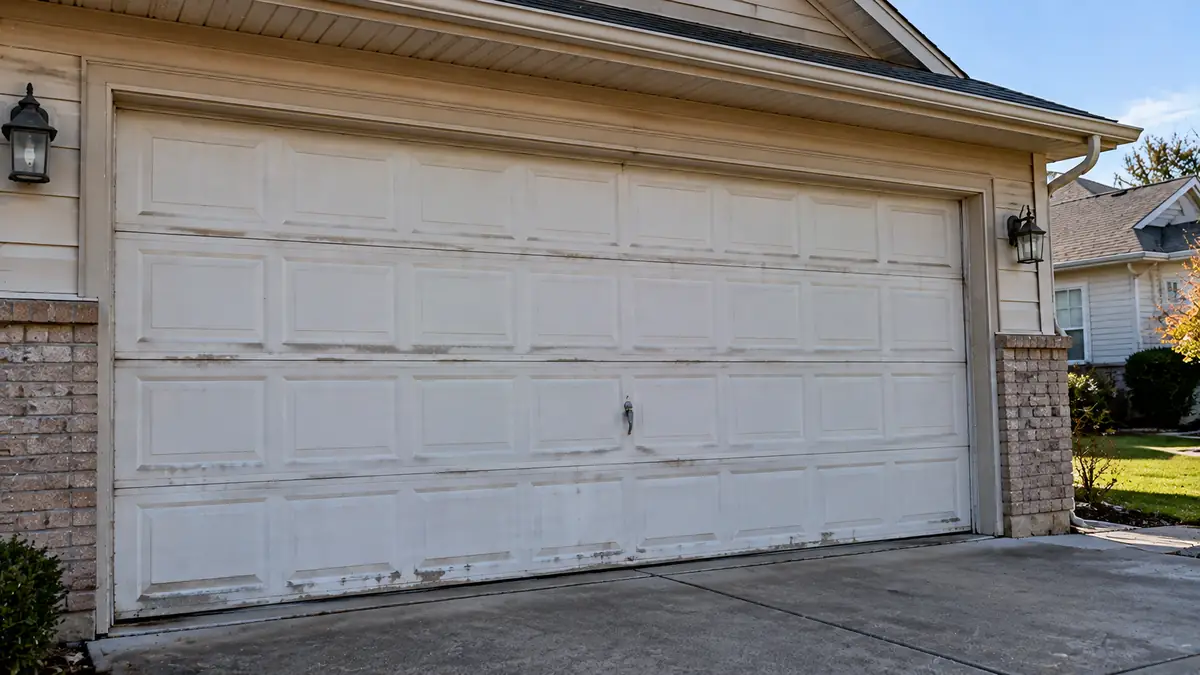
Do the arithmetic honestly
Ask for two written quotes from the same visit if you can: one for repairing what is broken now, and one for a new door installed. Then add up what the old door is likely to need in the next few years, not just today. If the springs were replaced last year but the cables, rollers and opener are all original, a repair today may be the first of three. If the door had a full refresh recently and only a seal or a section is damaged, repair is the obvious choice.
Do not forget the opener. Most last 10 to 15 years, so on a 20-year-old house it may be on its second unit or still on its first. Replacing the door and opener in the same visit avoids a second service call, and a new door may weigh differently enough that the old opener struggles anyway.
What a new door gets you in Nampa’s climate
Nampa sees about 108 freezing nights and about 55 days at 90°F or more in a typical year. An uninsulated single-layer steel door does almost nothing against either. A modern insulated door, especially a three-layer steel door, noticeably changes the temperature of an attached garage and of rooms above or beside it, and it is quieter and stiffer as well. Newer doors also come with fresh springs sized for their weight, new rollers and new seals, so you reset the clock on every wear part at once.
Style matters to resale and, in many subdivisions, to the HOA. The garage door installation page covers construction, styles and the City of Nampa permit rule, and our post on replacing a door in an HOA neighbourhood explains the approval side.
A middle path: refresh the old door
If the panels are sound but everything else is tired, a full refresh can buy many more years: new springs (consider high-cycle), new cables, sealed nylon rollers, new hinges where they are worn, a new bottom seal and retainer, and a tune-up of the opener. It is a bigger visit than a single repair but considerably less than a new door, and it suits a door you are otherwise happy with. A tune-up visit is a good time to ask what a refresh would involve.
Questions to ask before deciding
- How many of the door’s wear parts are original?
- Is a matching section still available if one is damaged?
- How much life do the springs and cables have left?
- Is the opener worth keeping with a new door?
- What insulation and construction would suit how we use the garage?
A fair technician answers these plainly and puts both options in writing. If the conversation jumps straight to a new door before anyone has explained what is wrong with the old one, take your time.
Repair or replace: quick answers
Should I repair or replace a 20-year-old garage door?
Repair it if the panels are sound and the problem is a wear part like springs or cables. Replace it if several sections are damaged, parts cannot be matched, several major repairs are due at once, or the repair approaches half the price of a new door.
How long does a garage door last?
Roughly 15 to 30 years depending on construction and use. Single-layer steel sits at the low end and insulated multi-layer steel at the high end. Springs, cables, rollers and openers are replaced along the way.
Is it worth replacing just the springs on an old door?
Usually yes, if the door itself is sound. Springs are a normal wear part. It becomes less worthwhile when the cables, rollers and opener are also due and the panels are tired.
Does a new garage door add value to a home?
A new door is one of the most visible exterior upgrades and often helps a home show well. Buyers also tend to notice a tired, dented door as a sign of deferred maintenance.
Should I replace the opener when I replace the door?
Often, if the opener is 15 years old or more, lacks battery backup or struggles. Doing both in one visit saves a second service call.
Sources: housing ages from Census housing-age data for Nampa; climate from the NOAA 1991–2020 normals for the Boise Air Terminal station; door and part lifespans from This Old House and Angi.