
Kestrill Garage Door Repair Nampa
Garage Door Opener Installation in Nampa
Replacing a tired opener or upgrading a noisy one? How to choose the drive type, power and battery backup that suit a Nampa garage, and what a proper installation includes.
Kestrill is a referral service. We connect Nampa homeowners with independent local garage door companies and do not carry out repairs or installations ourselves.
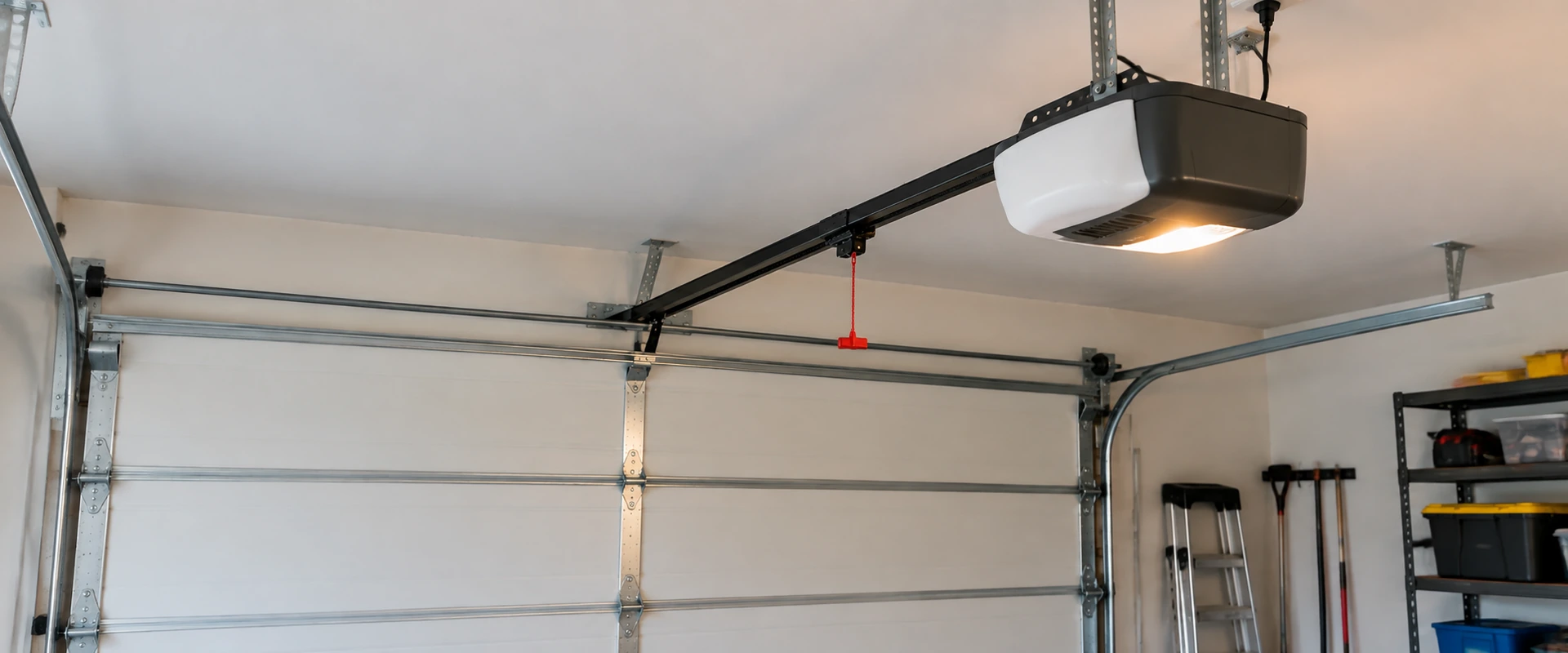
Most garage door opener installation, Nampa homeowners will tell you, happens for one of three reasons: the old opener finally died, it was so loud it rattled the bedroom above, or the last power outage left the car stuck behind a door nobody could lift.
Whatever the reason, the choice is rarely about finding the biggest motor. It is about matching the opener to the door, the garage and the way your household uses it. This page walks through the signs that an opener is done, the four drive types, horsepower, battery backup and smart features, and what a careful installer does that a quick one skips.
Before you choose a new opener
- Run the balance test. With the door closed, pull the release cord, lift the door halfway and let go. If it drifts up or down, the springs need attention before any new opener goes on.
- Measure the door height. Standard rails suit 7-foot doors; 8-foot doors need an extension, and taller shop doors often need a wall-mount unit.
- Look up. Note the ceiling height, any storage racks, and whether there is an outlet near where the opener will hang.
- Check Wi-Fi at the door with a smartphone if you want smart features.
- Decide on battery backup before ordering; it is easier to include it from the start.
Signs it is time for a new opener
- It is 15 years old or more. Most openers last 10 to 15 years. Plenty of original units from Nampa’s 2000s building boom are now well past that.
- It was made before 1993. Without photo-eyes and auto-reverse it does not meet the federal safety standard and should be retired, not repaired.
- It keeps needing repairs. A second stripped gear or a second board in a few years is the opener telling you something.
- It wakes the house. An old chain drive under a bedroom can be heard through the ceiling at 6 a.m.
- It strands you in every outage. No battery backup means no door until the power returns.
- It uses an old fixed-code remote. Modern rolling-code remotes change the signal every press; old systems can be copied or triggered by a neighbour’s remote.
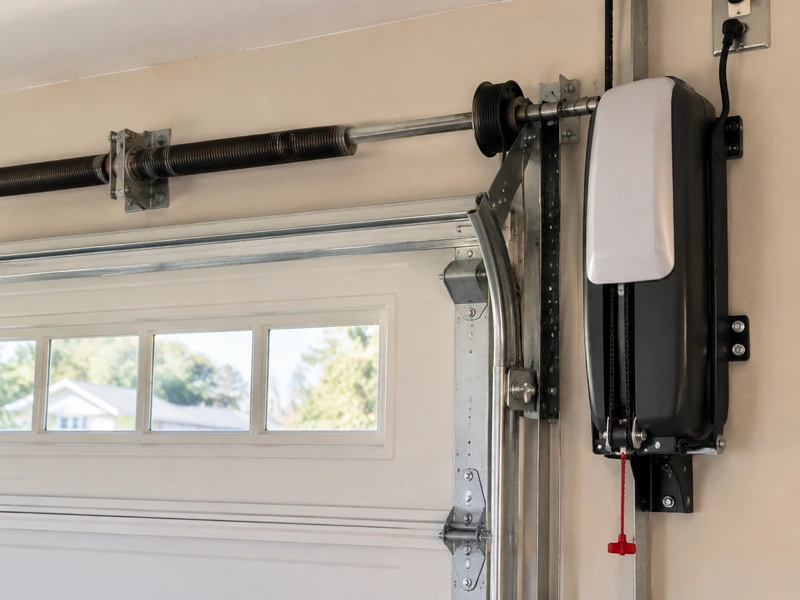
An opener that is simply struggling may not be the problem at all. If the door is out of balance or a spring is weak, a new opener will struggle too, and it will wear out early. That is why the first step of any installation should be a check of the door itself.
Chain, belt, screw or wall-mount?
Every type opens a door perfectly well. The differences are noise, maintenance, where the opener sits and how much it costs relative to the others.
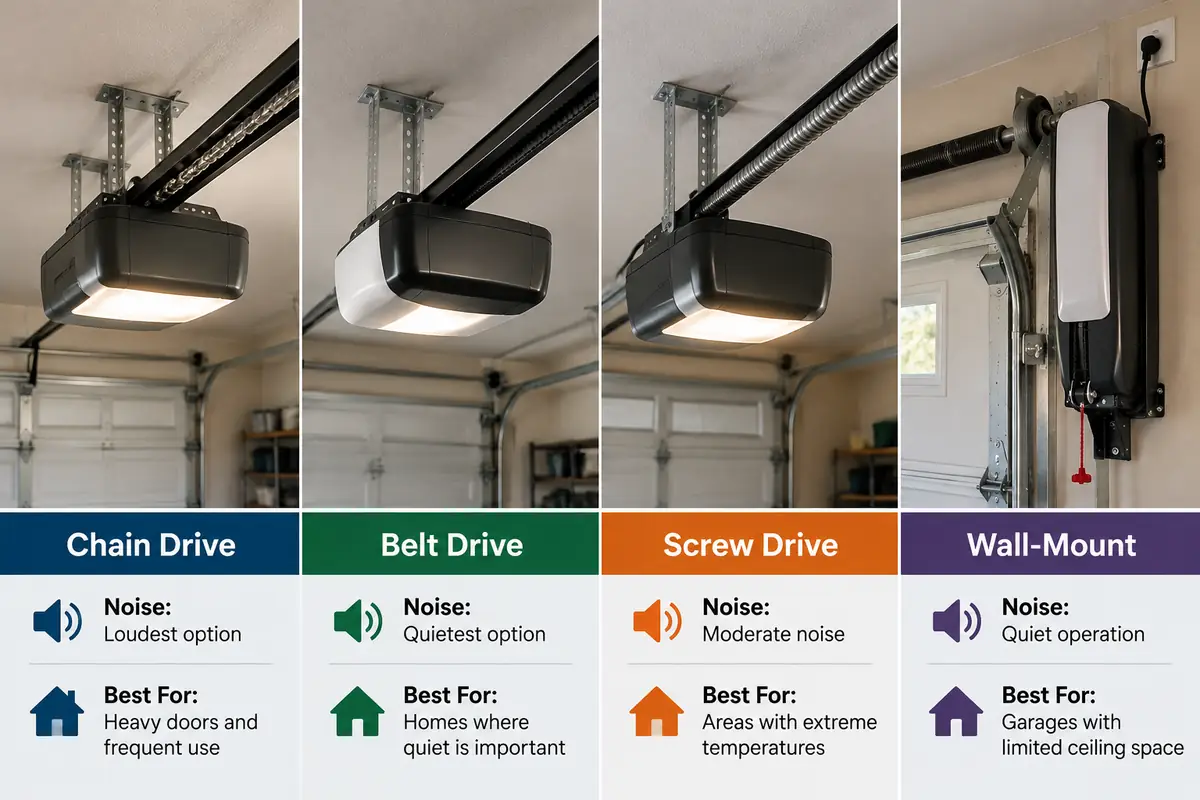
| Drive type | Noise | Maintenance | Good fit for |
|---|---|---|---|
| Chain drive | Loudest; clanks and vibrates | Occasional chain tension and lubrication | Detached garages, heavy doors, tight budgets |
| Belt drive | Quiet and smooth | Very little; check belt tension now and then | Garages under or beside bedrooms; most attached garages |
| Screw drive | Moderate | Lubricate the screw rail periodically | Heavier doors in moderate climates; fewer moving parts |
| Wall-mount (jackshaft) | Very quiet; no rail overhead | Very little | High or vaulted ceilings, storage racks, car lifts, shop doors |
In most Nampa homes with an attached garage, a belt drive is the default choice because of the noise. Wall-mount openers have become popular in newer homes with tall ceilings, where homeowners want overhead storage. They need a torsion spring system and a little room beside the door, so they do not suit every garage.
Climate plays a small part too. Screw-drive openers rely on a long threaded rod, and some older designs were known to slow down in deep cold and get noisy in heat. Nampa runs from January lows near 21°F to July highs around 91°F, so if you lean toward a screw drive, ask whether the model is rated for that range. Belt and chain drives are less fussy about temperature.
Half or three-quarter horsepower?
Horsepower matters less than people think, because the springs carry the door’s weight and the opener only guides it. A properly balanced single steel door runs fine on a 1/2 HP opener. A heavier insulated two-car door, a wood carriage-style door or a tall shop door is better matched to 3/4 HP or the equivalent DC motor, because the opener runs cooler and lasts longer when it is not working at its limit.
Many newer openers use DC motors with soft-start and soft-stop. They are quieter, gentler on the door and typically pair well with battery backup. The label horsepower on a DC opener is often an equivalence rather than a direct measure, so it is worth asking the technician which unit is matched to your door’s weight rather than chasing the biggest number.
Battery backup and smart features for Nampa outages
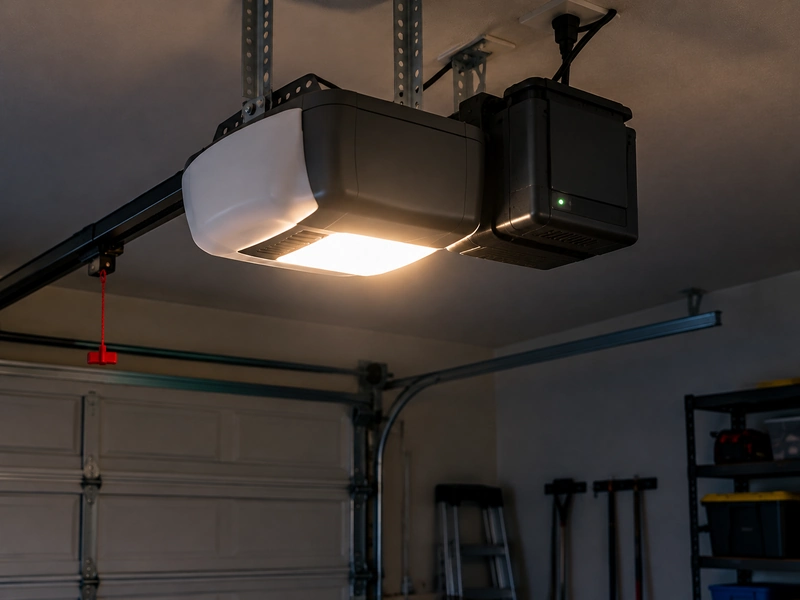
If one feature earns its keep here, it is battery backup. PowerOutage.us logged 55 outages in Nampa over the 90 days to late October 2026, with power usually back in about four hours. Windstorms in spring and thunderstorms in summer cause most of them. Without backup, an outage at 7 a.m. means pulling the release cord and lifting the door by hand, which is fine for some people and not possible for others.
A battery backup unit keeps the opener working for a limited number of cycles during an outage, enough to get the cars out and back in. Pair it with a plug-in surge protector, since the spike when power returns is a common way to lose a logic board.
Smart openers add app control, alerts when the door is left open and, on some units, a built-in camera. They are useful if you travel or if teenagers forget to close the door, but they only work as well as the Wi-Fi reaching the garage. Check the signal with a smartphone standing next to the door before relying on one.
What a professional installation includes
- Checks the door first. Balance, springs, cables and rollers. A new opener on an unbalanced door will fail early.
- Removes the old opener, rail, wiring and brackets, and takes them away.
- Fits a header bracket and a reinforcement bracket on the top section of the door, so the opener arm does not bend a thin steel panel.
- Hangs the head unit and rail on solid framing with proper hangers, square to the door.
- Installs new photo-eyes about 4 to 6 inches above the floor, and a wall control at least five feet up, out of small children’s reach.
- Programs remotes, the keypad and any smart features, then sets travel limits and close force.
- Tests everything, including the photo-eye test and the 2×4 auto-reverse test recommended in the CPSC garage door safety guidance.
A straightforward swap on a standard door usually takes a few hours. Expect longer for a wall-mount unit, a door that needs spring or roller work first, or a garage where new wiring or an outlet near the ceiling is needed. Ask for the price in writing and confirm whether it includes the reinforcement bracket, new sensors, haul-away and any rail extension for an 8-foot-tall door.
Keypads, remotes and sensors set up during installation
A new opener is a good moment to sort out everything that talks to it. Old remotes and keypads rarely work with a new unit, and the old photo-eyes are usually replaced too, because they are matched to the opener’s circuit.
- Remotes: decide how many you need for each driver and car. Most new openers also accept a small car-visor remote or the car’s built-in buttons.
- Exterior keypad: handy for kids, dog walkers and anyone who forgets keys. On a south or west wall it takes direct sun, so mount it where it is shaded if possible.
- Wall control: a lit button with a light switch and a lock function is standard. Mount it at least five feet up, within sight of the door, so nobody closes it without looking.
- Photo-eyes: new sensors at 4 to 6 inches off the floor, wired cleanly and aimed so low afternoon sun is less likely to hit the receiving eye on a west-facing garage.
- Lighting: many new openers have bright built-in LED lights; if you keep separate bulbs, choose ones labelled as compatible with garage door openers to avoid radio interference.
If your current opener works but the sensors keep acting up, that is a separate fix. The garage door sensor repair page explains the common causes.
Openers for shop, RV and oversized doors
Out toward Lake Lowell and along the county roads around Nampa, plenty of properties have a detached shop or RV garage with a door 10 to 14 feet tall. Standard residential rails are built for 7 and 8-foot doors, so taller doors need an extension kit or, more often, a wall-mount opener. Heavier doors need an opener rated for their size and weight, and shop doors that face the prevailing wind take extra punishment, so solid mounting matters as much as the motor.
If your shop door is commercial-grade or very large, make that clear up front, because not every residential technician carries the parts for it.
Garage door opener installation, Nampa: common questions
Should I get a 1/2 HP or 3/4 HP garage door opener?
For a balanced single steel door, 1/2 HP is plenty. For heavier insulated two-car doors, wood or carriage-style doors and tall shop doors, 3/4 HP or an equivalent DC motor runs with less strain and tends to last longer.
How long does garage door opener installation take?
A standard replacement on a balanced door usually takes a few hours. Wall-mount units, tall doors that need rail extensions, extra wiring or a door that needs spring or roller work first will take longer.
How long do garage door openers last?
Typically 10 to 15 years. Openers in hot garages, homes with frequent outages and surges, or on doors that run out of balance tend to wear out sooner.
Can I install a garage door opener myself?
Some handy homeowners do, but mistakes with the door balance, the force setting or the sensor height can make the door unsafe. A professional checks the springs and balance first and tests the safety reversal before leaving.
Can you just swap out an old opener for a new one?
Usually, yes, if the door is balanced and the springs are healthy. The old rail and brackets normally come out with the old unit, and new photo-eyes go in with the new opener, because old sensors are often not compatible.
Should I repair or replace my garage door opener?
Repair small faults on a younger opener. Replace when it is past about 15 years old, needs a major part like a motor or board, was made before 1993, or lacks features you now need, such as battery backup or rolling-code security.
Is battery backup worth it in Nampa?
For many homes, yes. Outages are frequent enough here that a backup unit, which keeps the opener working for a limited number of cycles, spares you from lifting a heavy door by hand on a dark morning.
Related garage door problems
Related problems people often run into at the same time:
Opener repair
The motor hums, clicks or does nothing at all. How to tell an opener fault from a door fault.
Sensor repair
The door starts down, then pops back up. Sun, dust and alignment are the usual suspects.
New door installation
When an old door is costing more than it is worth: insulation, styles, HOA rules and permits.
Not sure which one you are dealing with? The Nampa garage door repair overview walks through every common failure and the safe first steps for each.
Sources: outage counts from PowerOutage.us; safety testing from the CPSC garage door safety guidance; opener requirements from the federal garage door opener standard (16 CFR 1211); housing ages from Census housing-age data for Nampa.