
Kestrill Garage Door Repair Nampa
Broken Garage Door Spring Repair in Nampa
Heard a bang like a gunshot from the garage, and now the door will not lift? That is almost always a snapped torsion spring. Here is what to do, what to avoid and what the repair involves.
Kestrill is a referral service. We connect Nampa homeowners with independent local garage door companies and do not carry out repairs or installations ourselves.
If you are reading up on garage door spring repair, Nampa winters may well have had a hand in it. A broken spring is the most common major garage door repair here, and it has a habit of happening on the coldest morning of the month, ten minutes before you need the car.
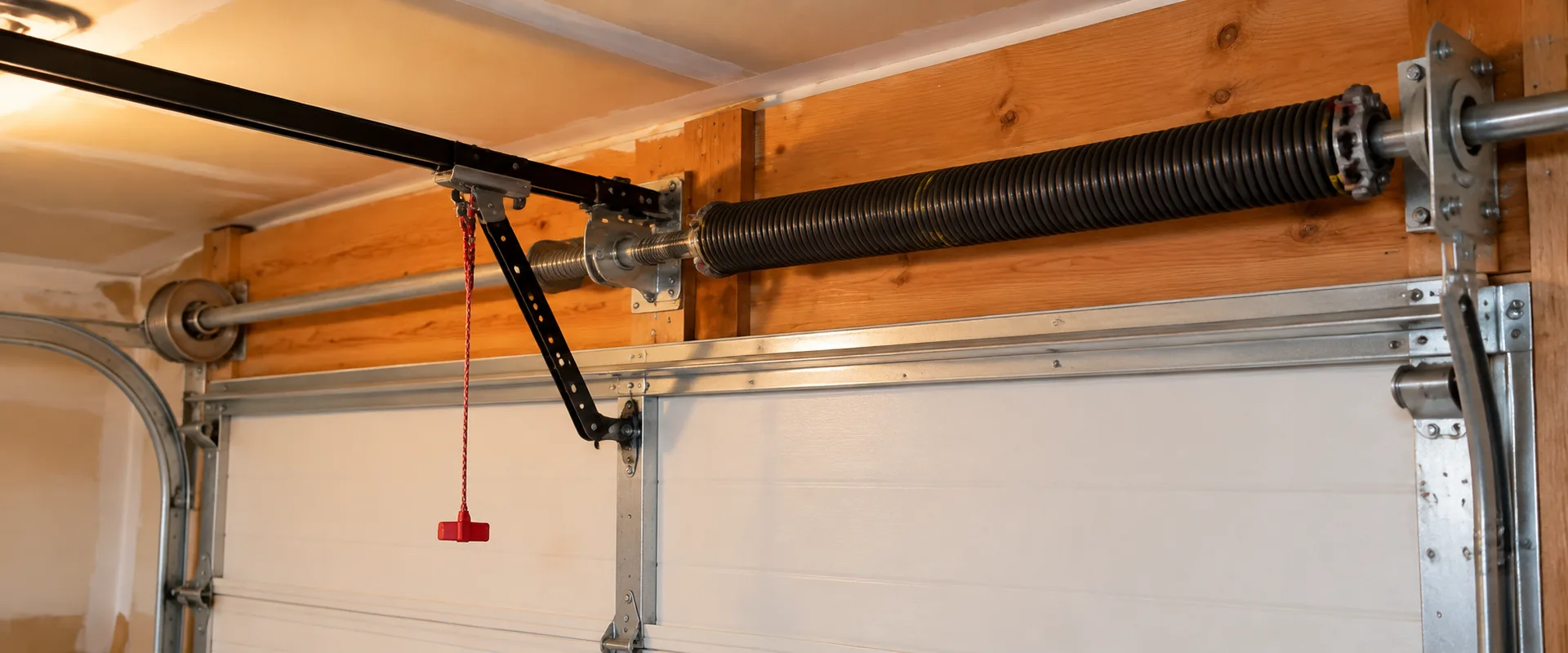
The springs, not the opener, lift your door. A typical double door weighs somewhere between 130 and 250 pounds, and a pair of tightly wound torsion springs on the bar above it carries almost all of that weight. When one snaps, the door suddenly weighs what it really weighs, and nothing in the garage is designed to lift that by itself. This page covers how to recognise a broken spring, what to do in the next ten minutes, why springs fail so often in Nampa, and what a proper repair looks like.
Do this first
- Leave a closed door closed. It is the safest position. Do not run the opener again; repeated attempts can strip its gear or bend the top section.
- If the door is stuck open or partway, do not pull the red release cord. Without spring tension the door can drop fast. Keep everyone out from under it.
- Hands off the spring, the cone-shaped ends and the bottom brackets. All of them hold dangerous tension, even on a broken spring.
- Unplug the opener so nobody presses a remote or wall button by habit.
- Need the car out? With the door fully closed and the cord pulled, two adults can lift the door and clamp the tracks below the bottom rollers. If it feels too heavy, stop and wait for a technician.
Signs your garage door spring is broken
A broken spring rarely keeps you guessing for long. Most homeowners notice at least two of these at once:
- A loud bang from the garage, often when nobody was touching the door. Springs tend to let go at rest, overnight or early in the morning.
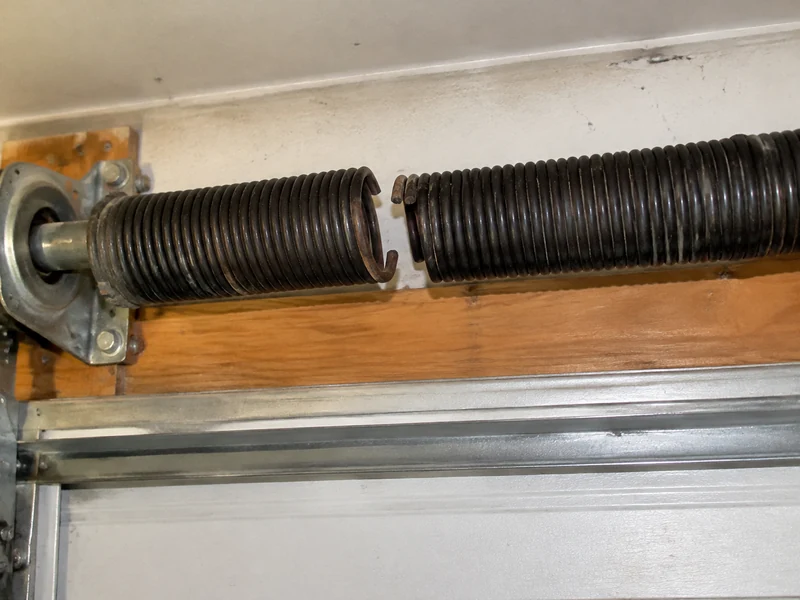
- A gap in the coil. Look at the bar above the closed door. A healthy torsion spring is one continuous coil; a broken one has a clean two-inch gap somewhere along it.
- The door opens six inches and stops, or the opener hums, strains and reverses. Many openers sense the extra weight and quit.
- The door feels like it is bolted to the floor when you try to lift it by hand after pulling the release.
- Cables hanging loose at the bottom corners or unwound from the drums at the top.
- The door rises crooked or jerks. On a two-spring door, one broken spring often leaves the door tilting.
Older single-car doors and some 1980s and 1990s homes use extension springs instead. Those run along the horizontal tracks on each side. A broken one sags or dangles, and if no safety cable runs through it, the pieces can whip across the garage when it snaps. If you see a stretched spring hanging with no cable through the middle, keep people out of that area until it is replaced.
Why springs break in Nampa
Springs do not fail at random. They wear out on a count of cycles, one open plus one close, and Nampa adds a few local pressures on top.
Cycle count does most of the damage
A standard builder-grade torsion spring is rated for roughly 10,000 cycles. That sounds like plenty until you do the arithmetic for a household that uses the garage as its front door:
| Cycles a day | 10,000-cycle spring lasts about | 25,000-cycle spring lasts about |
|---|---|---|
| 2 (one trip out and back) | 13–14 years | 30+ years |
| 4 (a typical family) | 6–7 years | 17 years |
| 6 (school runs, errands, the dog) | 4–5 years | 11 years |
| 8 or more (garage used as the main entrance) | 3–4 years | 8–9 years |
Cold mornings finish off tired springs
Boise-area NOAA normals give the valley about 108 nights a year at or below freezing, and January lows average close to 21°F. Cold does not snap a healthy spring, but it is the last straw for one near the end of its rating. Grease stiffens, the door gets harder to move, and the spring that has been quietly cracking for months finally lets go. In mid-January 2024 temperatures dropped to the single digits and Nampa picked up about seven inches of snow in a day, the sort of week when torsion spring calls stack up across the valley.
Thousands of doors on their second or third set
Nampa’s largest group of homes, about 11,539 of them, was built between 2000 and 2009. Do the cycle maths on a 20-year-old door and you can see why so many are on their second or third set of springs by now. In newer subdivisions built since 2010, the first broken spring usually shows up somewhere around year six to eight, right on schedule for a 10,000-cycle part.
Mismatched or undersized replacements
A spring has to be sized to the weight of the door: wire thickness, inside diameter and length all matter. When a previous repair used whatever was on the truck rather than the right size, the door ends up out of balance and the new spring works harder than it should. If your last broken spring was replaced only a few years ago, an undersized or mismatched spring is worth asking about.
Torsion vs extension springs
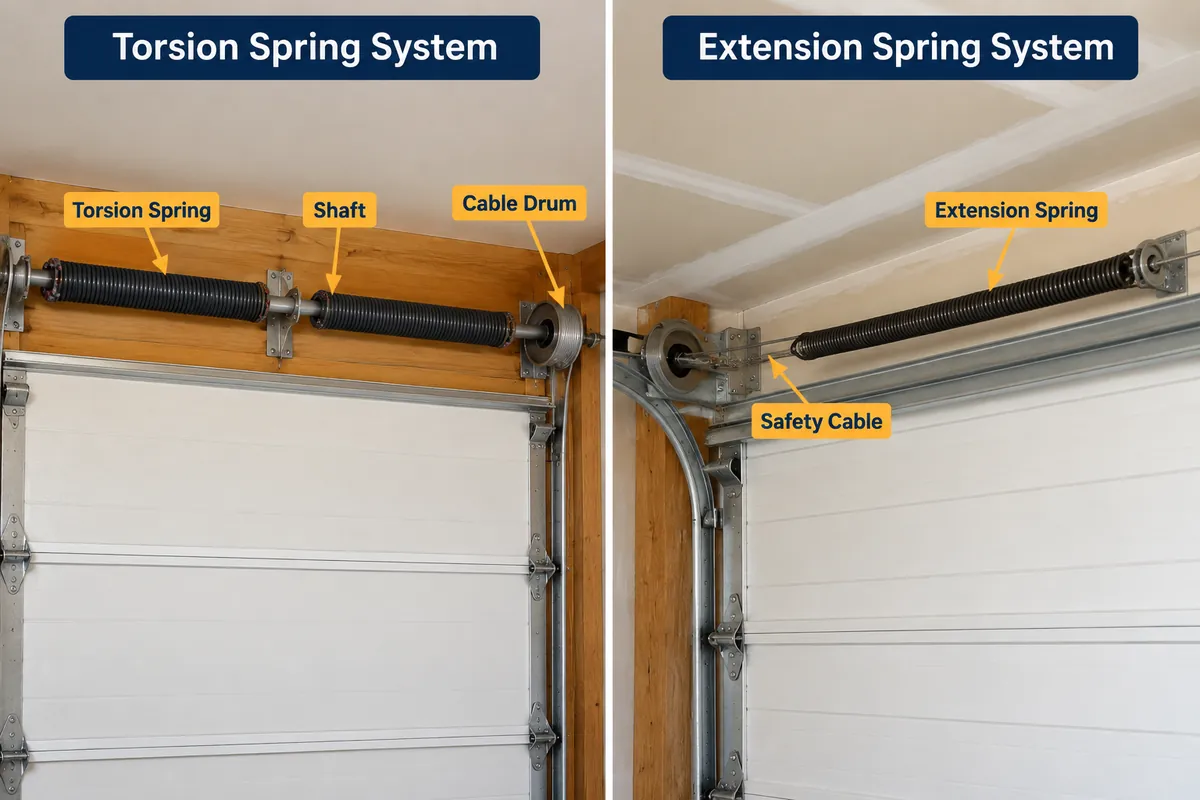
Most Nampa homes built since the 1990s have torsion springs mounted on a steel shaft directly above the door. Extension springs show up on older and lighter doors. The difference matters, because it changes what a repair involves and how a broken spring behaves.
| Torsion springs | Extension springs | |
|---|---|---|
| Where they sit | On a shaft above the closed door | Along each horizontal track |
| Typical doors | Most double doors and newer homes | Older, lighter or single-car doors |
| How they fail | Snap with a bang; a gap appears in the coil | Stretch out or snap; can fly loose without a safety cable |
| Ride quality | Smoother, more controlled travel | Bouncier, more noise |
| Repair notes | Wound with winding bars to a set number of turns | Replaced in pairs with safety cables checked or added |
If your door still runs on extension springs and one has broken, it is a reasonable time to ask whether converting to a torsion system makes sense. It is not always necessary, but on a heavy door it usually gives a smoother, safer ride.
What a technician does on a spring repair
- Secures the door in the closed position, usually with clamps on the tracks, so nothing can move unexpectedly.
- Releases any remaining tension on the old spring with proper winding bars, never screwdrivers.
- Measures the old spring (wire size, inside diameter, length and wind direction) and checks the door’s weight so the new springs match it.
- Installs the new springs, then inspects the cables, drums and center bearing that work alongside them.
- Winds the springs to the correct number of turns and tests the balance: a well-balanced door stays put when stopped halfway.
- Lubricates the new springs and moving parts, then checks the opener’s force and travel settings and runs the auto-reverse test.
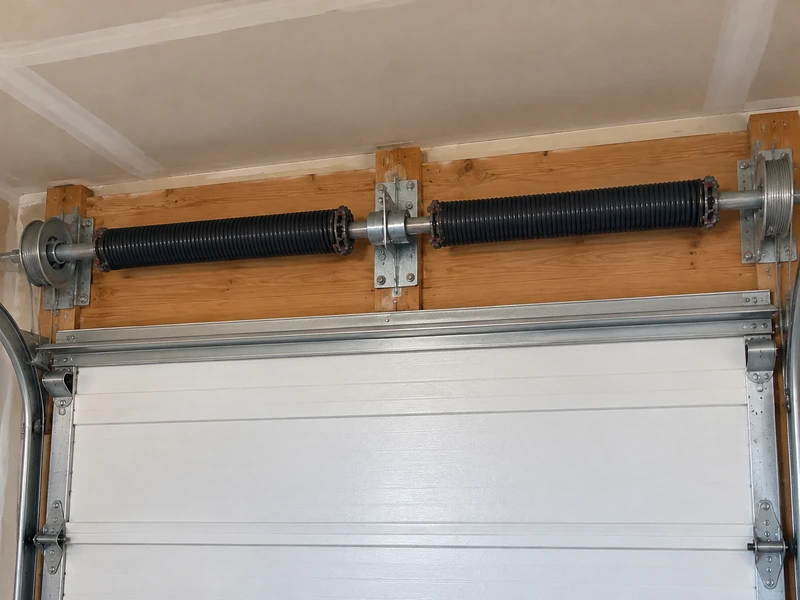
On a standard two-spring residential door, the job usually takes somewhere around an hour. Heavier doors, oversized shop doors or a door where cables also came off the drums take longer. Before any of it starts you should have a written price that names the springs being fitted.
Why both springs are usually replaced together
If your door has two springs and only one broke, the survivor has done exactly the same number of cycles. It is already near the end of its life, and it will often break within months. Replacing both at once keeps the door balanced, since an old spring and a new one pull differently, and saves a second visit and a second service fee. It is standard practice, not an upsell. What you can reasonably expect is an explanation of why, and a price for both on paper before the work begins.
Is a high-cycle spring worth it?
High-cycle springs are rated for 25,000 to 50,000 or more cycles instead of 10,000. They are longer or made from heavier wire, so they cost more up front and need enough room on the shaft. For a household that opens the door six or eight times a day, the arithmetic usually favours them, because you avoid replacing springs every four or five years. For a door that runs twice a day, standard springs are fine.
Is it safe to fix a garage door spring yourself?
No. A wound torsion spring on a typical double door stores enough energy to throw a winding bar across the garage or break the bones in a hand. Loosening the bottom brackets, where the cables attach, is just as dangerous because they hold the same tension. The CPSC garage door safety guidance tells homeowners to have an unbalanced door serviced by a professional, and springs are the main reason why.
What you can do safely: watch for the warning signs above, lubricate the coils twice a year with a garage door lubricant, and run the balance check. With the door closed, pull the release cord, lift the door halfway by hand and let go. If it drifts down or shoots up, the springs need attention.
Check the opener too
If the opener was run several times against a broken spring, it may have taken damage of its own: a stripped drive gear, a bent rail or a creased top door section where the opener arm pulled on dead weight. A good technician will look. If the opener now hums without moving the door even after new springs go in, the garage door opener repair page explains what has likely failed.
Garage door spring repair, Nampa: common questions
What should I do if my garage door spring is broken?
Stop using the door and the opener, leave the door closed if it is closed, and keep people clear of it. Do not touch the spring or the bottom brackets. If you must get a car out, two adults can lift a released, fully closed door and clamp the tracks, but waiting for a technician is safer.
Will a garage door still work with a broken spring?
Usually not properly. Most openers are designed to move a balanced door, not lift its full weight, so they strain, stop after a few inches or reverse. Forcing it can strip the opener’s gear or bend the top section of the door.
Can you manually lift a garage door with a broken spring?
Sometimes, but it is heavy and risky. A double door without spring help can weigh well over 150 pounds. Only try it with the door fully closed, the release cord pulled and two adults lifting, and never leave it propped up without clamps on the tracks.
Can I use my garage door with only one spring?
Not safely. On a two-spring door, the remaining spring is carrying a load it was never sized for, the door runs unbalanced, and the cables and opener take extra strain. Treat a single broken spring as a reason to stop using the door until both are replaced.
What causes a garage door spring to break?
Mostly metal fatigue from cycle count. Each open and close flexes the steel, and after roughly 10,000 cycles on a standard spring it cracks. Cold mornings, poor lubrication, an out-of-balance door and springs sized wrong for the door all speed that up.
How long do garage door springs last?
Standard springs are rated for about 10,000 cycles, which works out to roughly six to seven years for a family using the door four times a day. High-cycle springs rated for 25,000 cycles or more can last two to three times as long.
Can you replace just one garage door spring?
It is possible but rarely sensible. The unbroken spring has the same wear and usually fails soon after, and pairing an old spring with a new one can leave the door out of balance. Replacing both together is standard practice.
How long does garage door spring replacement take?
Around an hour for a typical two-spring residential door once the technician is on site. Extra time is needed if the cables came off their drums, the door is oversized, or the opener also needs attention.
Is it worth fixing a garage door spring, or should I replace the door?
For most doors, fixing the spring is clearly worth it. Springs are a normal wear part. Replacement only makes sense if the door itself is badly damaged, very old with several other failing parts, or the total repair cost approaches half the price of a new door.
Is it safe to replace a garage door spring yourself?
No. Torsion springs store enough energy to cause severe injuries, and the specialised tools and sizing involved make it a poor first-time project. Leave springs, cables and bottom brackets to a professional.
Related garage door problems
Related problems people often run into at the same time:
Cable repair
One side hangs lower or a cable has jumped the drum. Why this one needs hands-off treatment.
Opener repair
The motor hums, clicks or does nothing at all. How to tell an opener fault from a door fault.
Tune-up and maintenance
Balance, lubrication, hardware and safety checks that catch failures before they strand you.
Not sure which one you are dealing with? The Nampa garage door repair overview walks through every common failure and the safe first steps for each.
Sources: safety guidance from the CPSC garage door safety guidance; temperature normals from the NOAA 1991–2020 normals for the Boise Air Terminal station and the City of Nampa climate summary; housing ages from Census housing-age data for Nampa. Cycle-life figures are calculated from standard 10,000 and 25,000-cycle spring ratings.