Why Your Garage Door Won’t Close in the Afternoon Sun
If your garage door refuses to close in the afternoon sun but works perfectly at night, the safety sensors are almost certainly being blinded by direct sunlight. It is one of the most common and least understood garage door problems on west-facing Nampa homes, and it is usually fixable in a few minutes.
This guide explains how sunlight interferes with the sensors, why it is so common here, how to confirm that sun is the culprit, and five simple fixes to try before anyone replaces a part.
How the sun blinds a garage door sensor
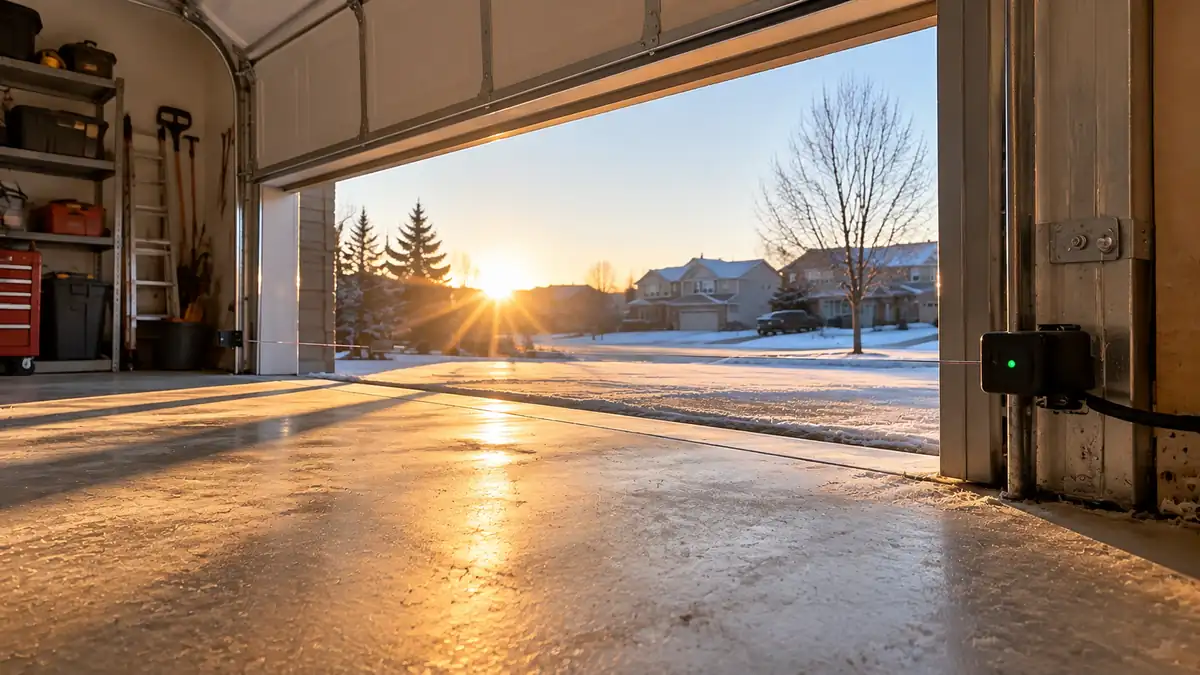
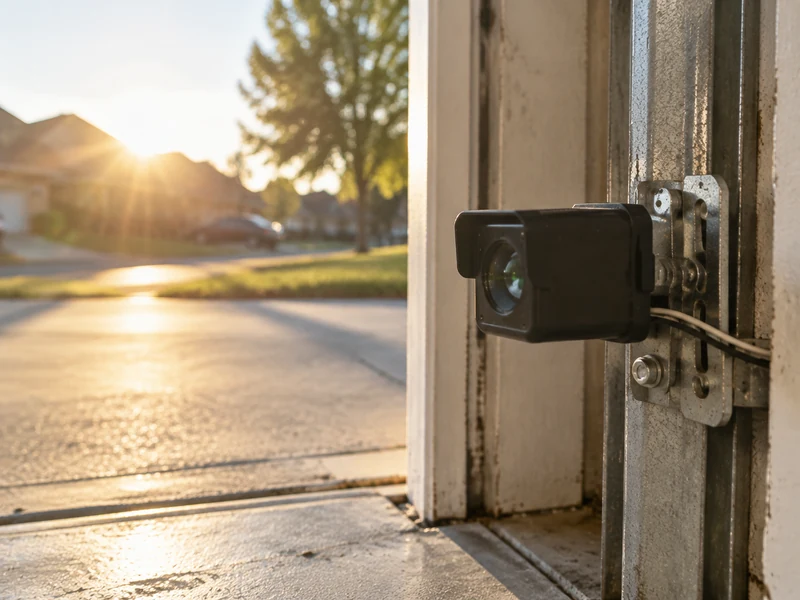
Every automatic opener sold in the U.S. since 1993 has a pair of photo-eye sensors mounted a few inches above the floor on either side of the door. One sends an invisible infrared beam; the other watches for it. If the receiving sensor loses the beam, the opener assumes a child, a pet or a bike is in the way and refuses to close, or reverses if the door is already moving.
Sunlight contains a lot of infrared. When the sun sits low enough to shine straight into the receiving sensor’s lens, it floods the sensor with light and drowns out the beam. As far as the opener is concerned, something is blocking the doorway. The door starts down, pops back up, and the opener light blinks at you. An hour later, when the sun has moved, everything works again.
Why it happens so often in Nampa
Nampa gets roughly 210 sunny days a year, according to the City of Nampa’s climate summary, and the high-desert air is clear and dry. Many homes in newer subdivisions face west or southwest, so the late sun shines straight up the driveway into the garage. In late spring and summer, when the sun sets far to the northwest and stays low for a long time, west-facing garages get a long window of direct light at floor level.
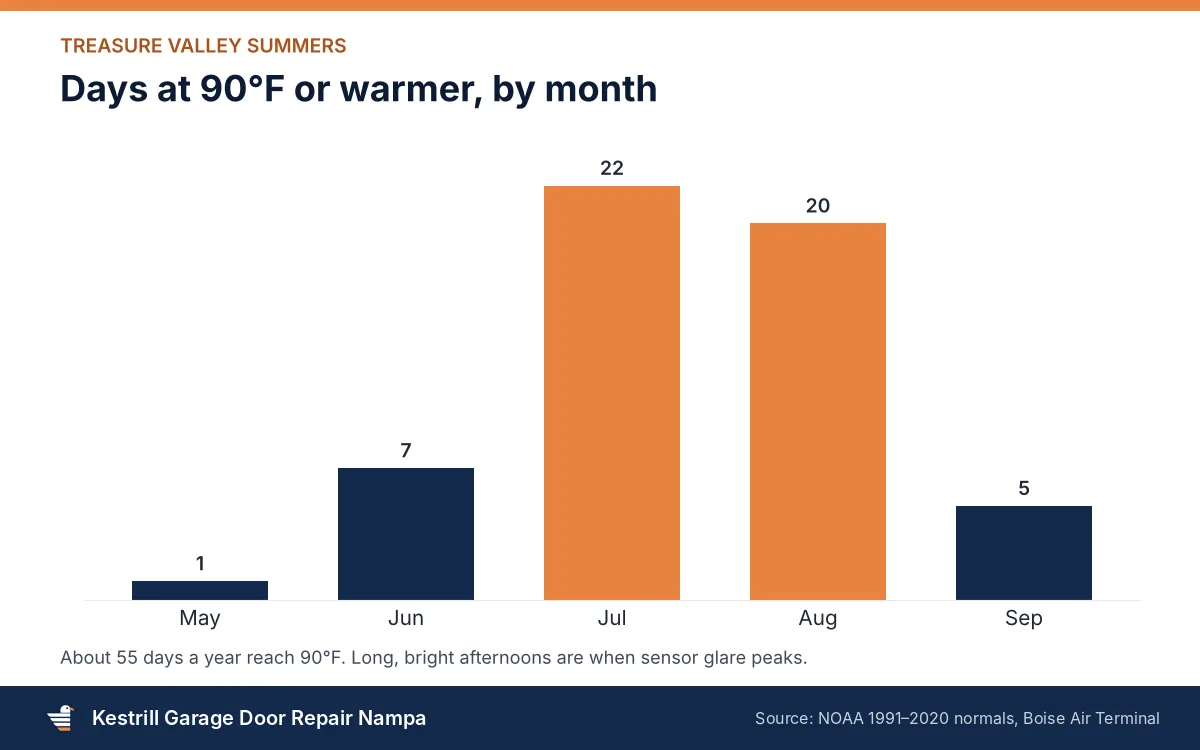
Dust makes it worse. A lens coated with fine field dust scatters incoming sunlight across the whole sensor, so a slightly dirty sensor is more easily blinded than a clean one. That is why many homeowners notice the problem getting worse through a dry, windy summer.
How to tell it is the sun, not a broken sensor
- The door fails only at a particular time of day, usually late afternoon or early evening, and works fine at night and on cloudy days.
- The receiving sensor’s indicator light flickers or goes off when the sun hits it, then comes back when you shade it with your hand.
- Holding the wall button down closes the door normally. That tells you the opener and door are fine and the sensor circuit is the only thing objecting.
- The problem started or got worse in spring and summer, and eases in winter when the sun stays higher in the south for west-facing garages.
If the door fails at all times of day, or the sensor light stays off even in shade, the cause is more likely alignment, wiring or a failed sensor. The garage door sensor repair page walks through those.
Five simple fixes for afternoon sun
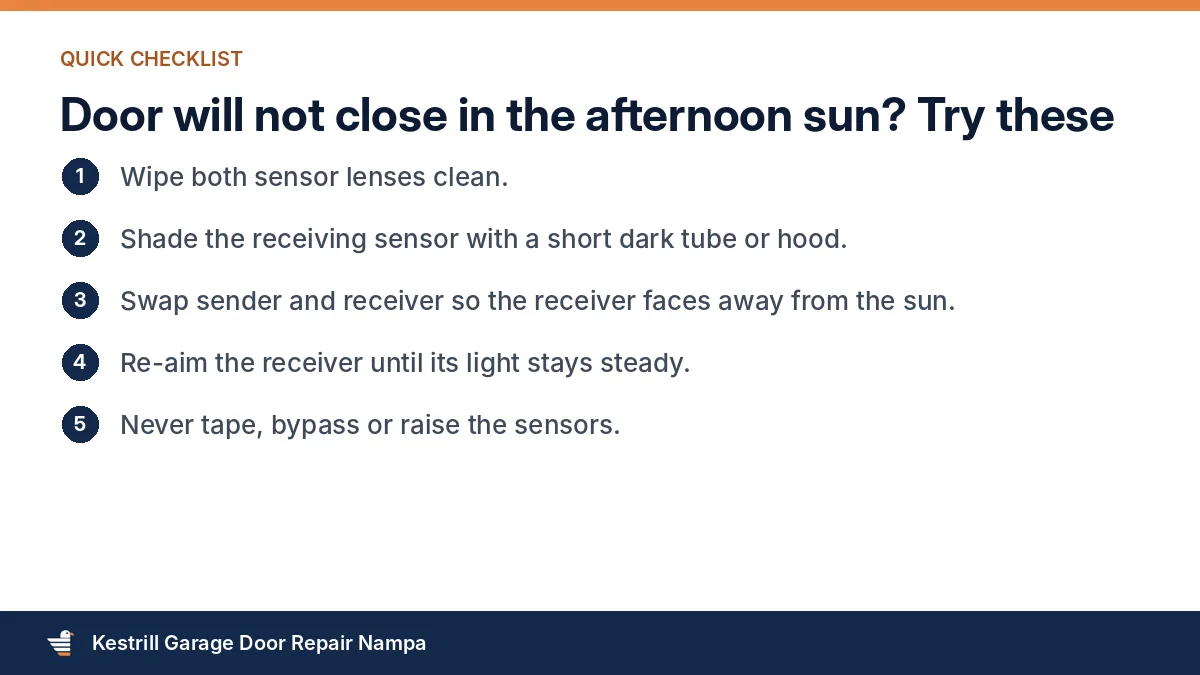
- Clean both lenses. A soft, dry cloth removes the dust film that scatters sunlight.
- Shade the receiving sensor. A short tube, such as a 2 to 3-inch length of dark pipe or a cardboard tube painted black, slipped over the receiver and pointed at the sender blocks the side light without blocking the beam. Some sensor makers sell small hoods for exactly this.
- Swap the sensors. If you are comfortable with low-voltage wiring, swapping the sender and receiver puts the receiver on the side facing away from the sun. Check which unit is which by its label or light colour first.
- Re-aim carefully. Sometimes tilting the receiver a few degrees away from the sun, while keeping its light steady, is enough.
- Close the door earlier or hold the wall button. As a stopgap, holding the wall button while you watch the door close is a legitimate attended override.
What you should never do is tape the sensors, bypass them or move them up the wall out of the sun. They sit 4 to 6 inches off the floor because that is where a small child or a pet would be.
Which way does your garage face?
The direction your garage door faces decides when, and whether, the sun gets into the sensors. At Nampa’s latitude the sun sets well to the northwest in June and well to the southwest in December, so the problem shifts through the year:
| Garage faces | When glare is most likely | Notes |
|---|---|---|
| West | Late afternoon and evening, spring through early fall | The classic case; long, low summer sun shines straight up the driveway |
| Northwest | Summer evenings around sunset | Often only a few weeks around the longest days |
| Southwest | Winter afternoons | Low winter sun can reach the floor in December and January |
| East | Early morning, especially in summer | Shows up as a door that will not close when you leave for work |
| North or south | Rarely | If the door fails at set times, look for reflections off a car, window or white wall |
Reflections deserve a mention. A white car parked in the driveway, a neighbour’s window or a pale stucco wall can bounce sunlight into a sensor that never sees the sun directly. If the timing is consistent but the geometry does not add up, look for a bright surface in line with the receiver.
Making the fix last
Once you have found a fix, a few habits keep the door reliable through the summer. Wipe the lenses every few weeks during dusty spells; Canyon County’s dry fields and windy afternoons coat them faster than people expect. Check that the shade tube has not been knocked out of line by a bike or a bin. And run the photo-eye test once a month: wave a broom handle through the beam as the door closes, and make sure it reverses. A fix that blocks sun glare should never stop the sensors seeing an actual obstruction.
If you are replacing an opener anyway, ask about sensor models designed to reject sunlight better. Many newer sensors are noticeably less sensitive to glare, and the opener installation page covers what to look for. For a broader look at summer and winter problems around Nampa, the Nampa garage door repair overview covers the main seasonal causes.
When to bring in a technician
If shading and cleaning do not solve it, a technician can check whether the sensors are degrading, whether the wiring is picking up interference, or whether the opener’s sensor input is faulty. Some newer sensors handle sunlight far better than older ones, and replacing a tired pair is a quick job. If the door also reverses near the floor at other times of day, the opener’s travel limit or close-force setting may need adjusting, which is part of the safety system and belongs with a professional.
Other afternoon problems that look similar
Hot afternoons can cause a couple of other faults that are easy to confuse with sun glare. A door that has dried out over a hot summer can bind slightly in the tracks, and an opener with its close force set low may reverse when the door meets that extra resistance near the floor. Lubricating the hinges and roller bearings, and wiping the tracks clean, often helps. A badly overheated opener on a west-facing garage in July can also behave erratically until it cools. If the door reverses only near the floor, not partway down, the sensors are probably not the problem.
Afternoon sun and garage door sensors: quick answers
Why won’t my garage door close in the afternoon sun?
Low sun can shine into the receiving photo-eye sensor and drown out its infrared beam. The opener reads that as an obstruction and refuses to close. Shading or swapping the sensors usually fixes it.
Can sunlight really affect garage door sensors?
Yes. Sunlight contains strong infrared light, and when it hits the receiving lens directly it can overwhelm the beam from the other sensor. It is a well-known cause of doors that fail at the same time each day.
Should I move my garage door sensors higher to avoid the sun?
No. Sensors belong about 4 to 6 inches above the floor so they detect small children and pets. Shade the receiver or swap sides instead.
Will the sun damage my garage door sensors?
Not usually. Sunlight interferes with the beam while it is shining on the lens but does not normally harm the sensor. Years of heat and UV can age the plastic housings and wiring, so cracked or faded sensors are worth replacing.
Which garage door sensor is the receiver?
Check the labels or the indicator lights; on many systems the receiving sensor shows a light only when it sees the beam. Your opener manual identifies them by colour.
Sources: sunshine from the City of Nampa climate summary; temperature normals from the NOAA 1991–2020 normals for the Boise Air Terminal station; sensor height and safety from the CPSC garage door safety guidance.